Tronscan is the TRON network's first block explorer for reading accounts, transfers, contracts, resources, and governance data
Tronscan is the public search layer for TRON, the place where TRX payments, TRC-20 token movements, smart contracts, blocks, votes, and resource costs become readable. A user enters a wallet address, transaction hash, token name, block number, or contract address and sees the on-chain record behind it. It is especially useful for checking USDT transfers on TRON, confirming TRX movement, reviewing Energy and Bandwidth use, and understanding whether a contract or token page matches the activity a wallet is about to trust.
Reading a TRX or USDT Transfer From the Hash
A transaction hash is the cleanest way to answer a simple question: did the transfer land on-chain? Paste the hash into the explorer search bar, then review the status, timestamp, sender, receiver, token, amount, and fee-related resource usage. For TRC-20 transfers such as USDT, the token movement appears separately from the raw TRX balance movement because the transfer is executed through a token contract.
Confirmations matter less as a guessing game and more as a record of final inclusion. Once a transaction appears in a produced block and the status shows success, the page gives both parties a shared reference. That shared reference is why support teams, exchanges, OTC desks, and everyday wallet users ask for the transaction ID instead of screenshots.
Accounts Show Balances, Permissions, and Token Activity
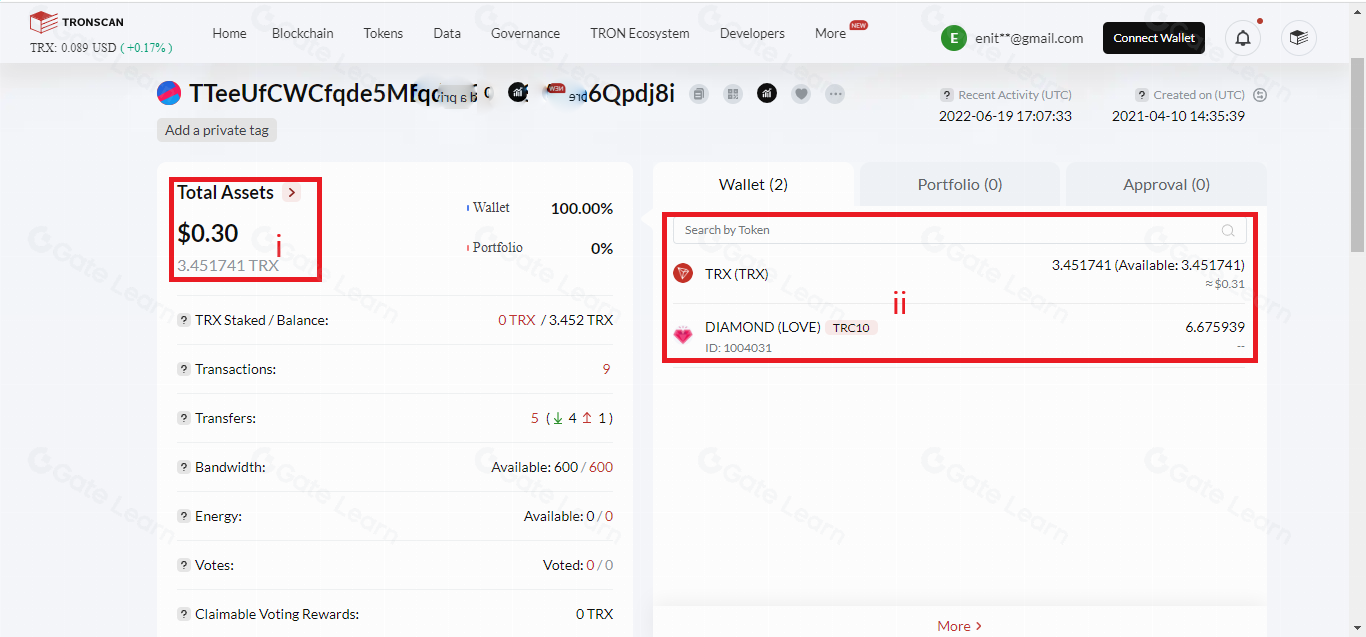
Wallet pages on Tronscan pull together the details that otherwise sit across many different records. The account view shows TRX, token balances, recent transfers, contract interactions, and resource information. When an address participates in staking or governance, the same area connects the account to voting behavior and related network roles.
Account permissions deserve attention because TRON supports more than a single-key spending model. Multisig settings and permission structures define which keys have authority to sign actions. A business wallet, custody setup, or shared treasury uses those settings to reduce operational risk, while a personal wallet owner uses the page to see whether their account has unexpected authority rules.
Energy and Bandwidth Explain the Real Cost of a Transaction
TRON does not present every cost as a plain gas number in the same style as Ethereum. Its resource model uses Bandwidth and Energy. Bandwidth relates to ordinary transaction data, while Energy is consumed when a smart contract runs. If an account lacks enough available resources, the transaction burns TRX to cover the shortage.
The resource calculator and Energy rental tools make this model easier to plan around. Someone sending a simple TRX payment reads one type of cost profile; someone moving USDT or calling a DeFi contract sees a different one because contract execution uses Energy. Tronscan makes those resource effects visible after the transaction, which helps users understand why two transfers with similar dollar value produce different costs.
Token Pages Separate Official Assets From Lookalikes
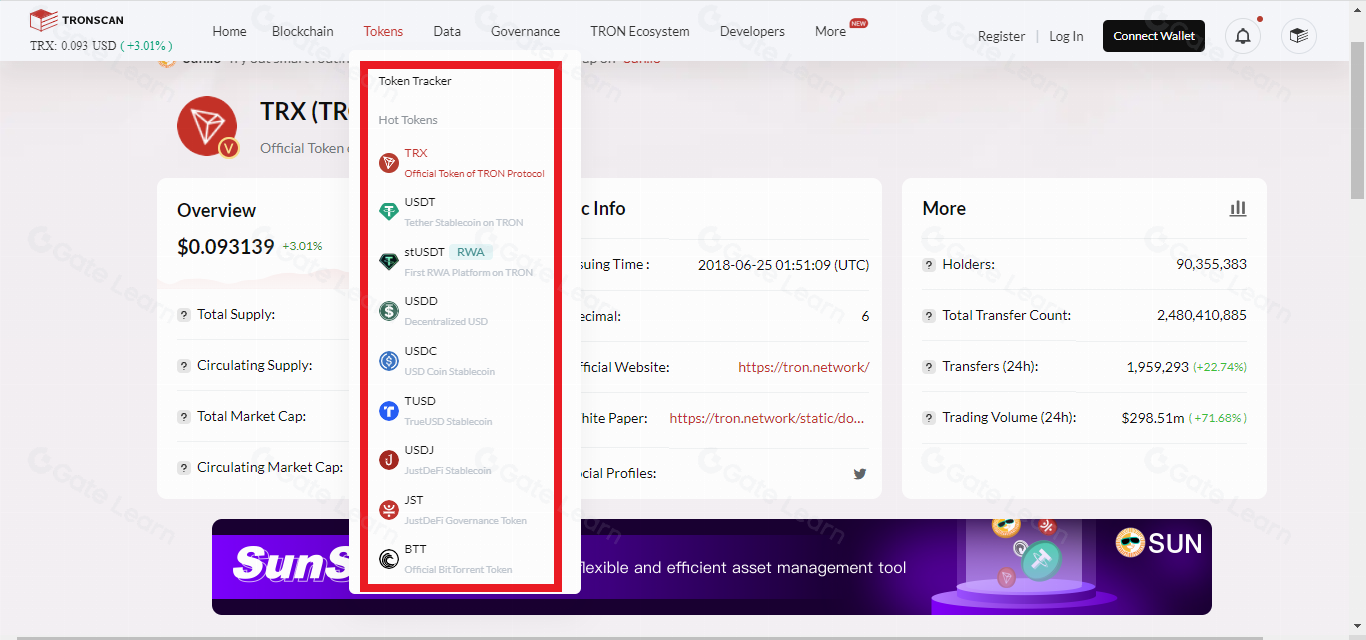
TRON has official tokens, TRC-20 assets, meme launches, stablecoins, wrapped assets, and project tokens. Token pages organize supply data, holders, transfers, contract addresses, and market-facing labels when available. The exact contract address remains the most important identifier because a familiar name or ticker is easy to imitate.
On a token tracker page, USDT, TRX-related assets, SUN ecosystem tokens, and newer community assets sit beside transfer histories and holder distribution. That visibility matters when a user receives an unfamiliar token, checks a DEX pair, or compares a token shown in a wallet with the contract address promoted by a project. The explorer does not replace judgment, but it gives the raw records needed to spot obvious mismatches.
Contracts, Verification, and Developer Workflows
Smart contract pages show deployment information, calls, events, and source verification when the developer has published code for review. Verified code helps builders and analysts connect bytecode to readable contract logic. Unverified contracts still expose activity, balances, and transaction history, but the human-readable logic remains limited.
Developers use the explorer alongside TronWeb, TronGrid, TronBox, TronIDE, Java-tron, and API access. The same ecosystem includes tools to broadcast transactions, sign and verify messages, convert record token encodings, inspect deployed contracts, and submit contract verification. For applications that query the network repeatedly, API-key requirements shape how production access is managed instead of relying on casual browser lookups.
Governance Data Connects TRX Staking to Super Representatives
TRON governance runs through Super Representatives and voting. Staked TRX gives users voting power, and network participants direct that power toward validator candidates. The governance section displays Super Representatives, votes, staking parameters, proposals, and the public records behind those decisions.
This is where the explorer becomes more than a payment receipt viewer. A TRX holder reviewing staking activity sees how voting connects to block production and protocol management. Proposal pages add context for parameter changes because they show the change record on-chain rather than relying on secondhand summaries.
Where DeFi and Ecosystem Activity Appears
The TRON ecosystem includes lending, swaps, stablecoins, perpetual futures, meme launches, storage, cross-chain infrastructure, and wallet tooling. JustLend DAO, SUN, SunPump, SunX, USDD, stUSDT, TronLink, BTTC, BTFS, and GasFree appear as recognizable parts of that environment. Tronscan links these names to on-chain activity through accounts, contracts, token trackers, and analytics surfaces.
A DeFi user checks pool or lending contract addresses before approving token movement. A stablecoin user follows USDT transfers to confirm settlement. A builder watches contract calls and resource consumption after deployment. The same underlying explorer serves all of those workflows because the network publishes the ledger first and interpretation layers build on top.
Charts, Rankings, and Analytics Give the Network a Wider Shape
Single transactions answer narrow questions; analytics pages show the wider pattern. Charts cover active accounts, transaction trends, protocol revenue, stablecoin activity, account holdings, top accounts, top tokens, top contracts, and resource consumption. Rankings help identify busy contracts and heavily used assets without manually sampling block after block.
These views are strongest when treated as directional network intelligence. A sudden rise in transfers, a busy contract, or a growing token holder list points to activity worth investigating. The next step is still address-level or contract-level review, because aggregate charts explain scale while individual records explain exactly what happened.
Getting Started With a Clean Search Habit
Begin with the most precise input you have. A transaction hash gives the exact record. A contract address gives the exact program or token. A wallet address gives all visible account activity. Names and tickers are useful for discovery, but addresses reduce confusion on a chain where similar-looking assets exist.
- Use the search bar for transaction hashes, addresses, token names, contract addresses, and block numbers.
- Check the token contract address before trusting a balance, DEX page, or copied ticker.
- Read the transaction status and resource usage before assuming a transfer failed.
- Review account permissions when managing shared wallets or high-value addresses.
- Use developer tools for contract verification, transaction broadcasting, and API-backed monitoring.
Once the habit is in place, Tronscan becomes a routine checkpoint before and after activity. The explorer shows the ledger, and the user brings the context: who should have sent funds, which contract was expected, what amount was agreed, and which wallet should receive the asset.
Limits, Mistakes, and Safer Interpretation
Public blockchain data is transparent, but it does not automatically explain intent. A transfer page proves that an address sent or received tokens; it does not prove that the person behind the address is trustworthy. A verified contract improves readability; it does not promise a profitable or harmless outcome. Token balances show ownership records; they do not confirm that a token has deep liquidity or lasting demand.
The most common mistakes come from copying the wrong address, trusting a fake token ticker, ignoring Energy costs, or reading a failed transaction as a completed one. Tronscan gives the details needed to catch those errors: status, contract address, token standard, resource use, event logs, and recipient address. Read those fields before sending follow-up funds or opening a support ticket.
Other Explorers Fit Other Chains
Every major blockchain has its own data structure, so explorers are chain-specific. Etherscan serves Ethereum, BscScan serves BNB Smart Chain, Solscan serves Solana, and Bitcoin explorers focus on UTXO-style Bitcoin transactions. Tronscan belongs to TRON because it understands TRX, TRC-10, TRC-20, Super Representatives, and the network's resource model.
Cross-chain tools and portfolio trackers summarize balances across networks, but they flatten details that matter during troubleshooting. When the transaction, token, or contract lives on TRON, the native explorer gives the most direct path from a user question to the underlying on-chain record.
Frequently asked questions about Tronscan
- What does a failed TRON transaction show on the explorer?
- A failed transaction still appears as an on-chain record, but its status indicates failure and the page shows the resources consumed by the attempt. For contract calls, the event or execution details help explain whether the issue came from a rejected contract condition, insufficient Energy, or another execution problem. The funds involved in the rejected action remain governed by the final transaction result shown on the record.
- Can I check a TRC-20 USDT deposit before an exchange credits it?
- Yes. Use the transaction hash or receiving address to find the USDT transfer record on TRON. The page should show the sender, recipient, token contract, amount, timestamp, and success status. Exchanges still apply their own internal crediting process after on-chain settlement, so the explorer confirms blockchain delivery while the exchange account page controls when the deposit appears in the user's balance.
- Do I need a wallet login to search addresses and transactions?
- No wallet login is required for ordinary searches. Public account pages, transaction records, blocks, token pages, and contract activity are readable through the browser because they come from public blockchain data. Login methods matter for account-linked features, developer workflows, or personalized tools, but basic lookup works by entering an address, hash, token, contract, or block number.
- Which token standards appear on TRON explorer pages?
- TRON explorer pages cover native TRX activity along with TRC-10 and TRC-20 token records. TRC-20 is the standard most users encounter with assets such as USDT on TRON, while TRC-10 represents an older native token format. Contract pages and token tracker views help distinguish the standard, contract address, transfers, holders, and related activity.
- Why does a USDT transfer use Energy instead of only Bandwidth?
- USDT on TRON is a TRC-20 token, so moving it calls a smart contract rather than sending only native TRX. Contract execution consumes Energy. Bandwidth covers transaction data, while Energy covers the computation performed by the token contract. When the sender lacks enough available resources, TRX is burned to pay for the resource shortfall.
- Is the explorer enough to prove a token is legitimate?
- The explorer proves what exists on-chain: contract address, transfers, holders, balances, source verification when available, and transaction history. Legitimacy requires more context, including project ownership, liquidity, audits, permissions, and whether the contract address matches the one a trusted project publishes. The on-chain record is essential evidence, but it is one part of due diligence.